AI & ML Models
0.0 (0 reviews) • 0 downloads
Improving sleeping disorder diagnosis through ml approaches
र500
Improving sleeping disorder diagnosis through ml approaches
Technical Details
Improved diagnostic accuracy.
Reduced dependence on manual analysis.
Faster diagnosis and treatment planning.
Cost-effective and scalable solution.
Supports early detection of sleep disorders.
Reduced dependence on manual analysis.
Faster diagnosis and treatment planning.
Cost-effective and scalable solution.
Supports early detection of sleep disorders.
Secure Payment
Instant Download
GST Invoice
24/7 Support
About This Product
Sleep disorders affect millions of individuals worldwide and can significantly impact physical and mental health. Traditional diagnostic methods often require time-consuming clinical evaluations and specialized sleep studies. Machine learning approaches provide an effective solution for analyzing physiological and behavioral data to support early and accurate diagnosis of sleep disorders. The proposed system utilizes machine learning algorithms to classify different sleep disorders based on patient information and sleep-related parameters, thereby improving diagnostic efficiency and accuracy.
Introduction
Sleep is essential for maintaining overall health and well-being. Disorders such as insomnia, sleep apnea, narcolepsy, and restless leg syndrome can negatively affect daily functioning and quality of life. Conventional diagnosis usually involves polysomnography and expert interpretation, which may be expensive and inaccessible to many patients.
Recent advancements in machine learning have enabled the development of intelligent diagnostic systems capable of identifying sleep disorders from clinical data and physiological signals. These approaches can assist healthcare professionals in making accurate decisions and provide timely intervention for patients suffering from sleep-related conditions.
Existing System
Diagnosis mainly relies on polysomnography and manual interpretation.
Clinical assessments require experienced specialists.
Sleep studies are expensive and time-consuming.
Delays in diagnosis may affect patient health.
Disadvantages
High cost of sleep monitoring procedures.
Limited accessibility in remote areas.
Long waiting periods for diagnosis.
Possibility of human errors during interpretation.
Proposed System
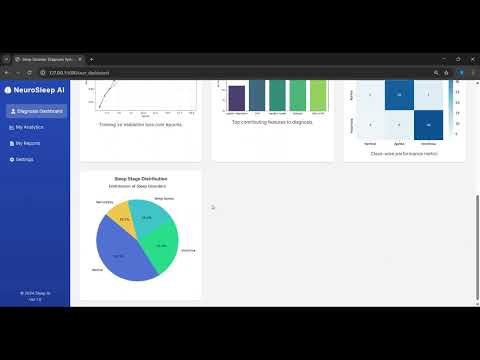
The proposed system applies machine learning techniques to classify sleep disorders using patient demographics, sleep duration, stress levels, heart rate, physical activity, and other physiological parameters. Data preprocessing and feature extraction are performed before training classification models to predict the type of sleep disorder. The system aims to provide fast, reliable, and cost-effective diagnosis support.
Advantages
Improved diagnostic accuracy.
Reduced dependence on manual analysis.
Faster diagnosis and treatment planning.
Cost-effective and scalable solution.
Supports early detection of sleep disorders.
Introduction
Sleep is essential for maintaining overall health and well-being. Disorders such as insomnia, sleep apnea, narcolepsy, and restless leg syndrome can negatively affect daily functioning and quality of life. Conventional diagnosis usually involves polysomnography and expert interpretation, which may be expensive and inaccessible to many patients.
Recent advancements in machine learning have enabled the development of intelligent diagnostic systems capable of identifying sleep disorders from clinical data and physiological signals. These approaches can assist healthcare professionals in making accurate decisions and provide timely intervention for patients suffering from sleep-related conditions.
Existing System
Diagnosis mainly relies on polysomnography and manual interpretation.
Clinical assessments require experienced specialists.
Sleep studies are expensive and time-consuming.
Delays in diagnosis may affect patient health.
Disadvantages
High cost of sleep monitoring procedures.
Limited accessibility in remote areas.
Long waiting periods for diagnosis.
Possibility of human errors during interpretation.
Proposed System
The proposed system applies machine learning techniques to classify sleep disorders using patient demographics, sleep duration, stress levels, heart rate, physical activity, and other physiological parameters. Data preprocessing and feature extraction are performed before training classification models to predict the type of sleep disorder. The system aims to provide fast, reliable, and cost-effective diagnosis support.
Advantages
Improved diagnostic accuracy.
Reduced dependence on manual analysis.
Faster diagnosis and treatment planning.
Cost-effective and scalable solution.
Supports early detection of sleep disorders.
Customer Reviews (0)
No reviews yet. Be the first!